
Last Updated: October 25, 2026
Quick Summary
The best cat enrichment furniture online matches the piece to your cat’s age, mobility, and play style, then checks materials, stability, and footprint. Cat enrichment furniture is any indoor structure that gives a cat a legitimate outlet for climbing, scratching, lounging, and exploring, including cat trees, wall shelves, scratcher lounges, condos, and window perches.
- The global cat furniture and scratchers market sits at roughly USD 1.6 billion in 2026, per Future Market Insights.
- Kittens and young adults want height and challenge, while senior cats need low-entry steps, wide platforms, and ramps.
- Sisal rope holds up to scratching far better than carpet, which shreds and traps claws.
- A freestanding tower should have a base footprint roughly as wide as the unit is tall, or wider.
- Judge a new piece over two to three weeks, not two days, since cats are cautious with new objects.
Table of Contents
- What to Look for in Cat Enrichment Furniture Online
- Best Cat Trees and Towers for Climbing and Scratching
- Cat Wall Shelves and Vertical Climbing Systems
- Cat Furniture for Apartments and Small Spaces
- Cat Furniture Materials and Features That Last
- Safety, Stability, and Multi-Cat Resource Distribution
- Signs Your Cat Is Actually Using the Enrichment Furniture
- Choosing Your Cat Enrichment Furniture at Paw Pro Source
- Frequently Asked Questions
What to Look for in Cat Enrichment Furniture Online
The global cat furniture and scratchers market sits at roughly USD 1.6 billion in 2026 and is projected to reach USD 3.1 billion by 2036, growing at a 6.8% compound annual rate, according to Future Market Insights’ market estimate. That growth tells you something useful: cat owners are buying more furniture than ever, and the best cat enrichment furniture online is no longer just a carpeted post in the corner. We curate pieces built around two things cats actually need, comfort and play.
Cat enrichment furniture is any indoor structure that gives a cat a legitimate outlet for climbing, scratching, lounging, and exploring. It includes cat trees, wall shelves, scratcher lounges, condos, and window perches. The right piece channels feline instincts instead of fighting them.
Below, we break down how to match furniture to your cat, then rank the categories worth your money.
A Decision Framework for Your Cat’s Age, Mobility, and Play Style
Most buying guides skip the cat and start with the product. We do it the other way around, because a $200 tower is wasted money on a cat that can’t or won’t use it.
Ask three questions before you shop:
- Age and mobility: Kittens and young adults want height and challenge. Senior cats or cats with arthritis need low-entry steps, wide platforms, and ramps rather than vertical leaps.
- Temperament: Shy cats prefer enclosed condos and high perches where they can observe. Bold, social cats do better with open shelves and multi-level gyms.
- Play style: A scratcher-and-lounger cat needs horizontal sisal surfaces. A climber needs vertical space. A pouncer needs a playground with hiding spots.
Match the piece to the cat, not the other way around. That single shift prevents most furniture returns.
Best Cat Trees and Towers for Climbing and Scratching
A cat tree is the workhorse of enrichment furniture, and it earns its place when it combines height, stable scratching surfaces, and a resting platform at the top. For a specific option, see this multi-level cat tower.
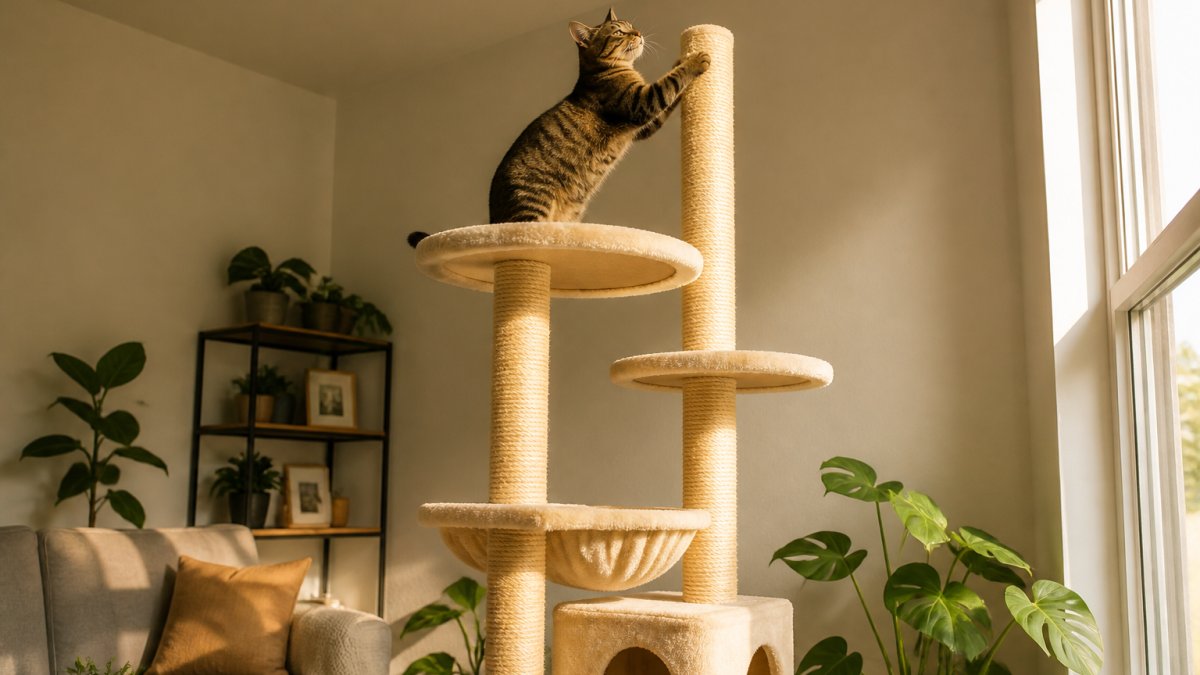
Best for: Climbers, young adults, multi-cat households.
Skip if: Your cat is senior or has limited mobility.
Cat Wall Shelves and Vertical Climbing Systems
Wall shelves turn dead wall space into a climbing route, which matters most in small homes.
If you want a ready-made route rather than piecing shelves together, a complete climbing circuit can be found. Watch out: cheap shelves anchored into drywall alone can pull free under a jumping cat.
Best for: Apartments, climbers, cats who love a window view.
Skip if: You rent and cannot drill into walls.
Cat Furniture for Apartments and Small Spaces
Small-space furniture wins on footprint, not features. A tall, narrow tower or a corner condo delivers vertical space without swallowing the living room.
For readers who want more options sized for tight layouts, a guide to durable cat furniture for small apartments covers additional picks and layout tips.
Best for: Studio and one-bedroom homes.
Skip if: You have room for a full climbing gym and want maximum enrichment.
Cat Furniture Materials and Features That Last
Materials decide whether a piece survives a year or a month. Sisal rope holds up to scratching far better than carpet, which shreds and traps claws. A sisal scratcher bed combines scratching and resting in one piece. Solid wood frames outlast particleboard, and removable, washable covers make long-term care far easier.
A 2010 review of environmental enrichment for indoor cats noted that cats appear to prefer comfortable resting options such as pillows or fleece beds, so look for plush, removable pads on any lounging surface (Environmental Enrichment for Indoor Cats). The ASPCA also lists cardboard boxes and non-toxic glue as low-cost DIY enrichment materials, a budget-friendly alternative to buying furniture (ASPCA Feline DIY Enrichment).
Best for: Heavy scratchers, durability-focused buyers.
Skip if: You want a purely decorative piece with no scratch surface.
Safety, Stability, and Multi-Cat Resource Distribution
Stability is the feature buyers overlook until a tower tips. A cat launching off a top platform can generate a surprising lateral load, so the base width, frame material, and anchoring method matter more than the height on the spec sheet. Use this checklist before you buy or assemble:
- Base-to-height ratio: A freestanding tower should have a base footprint roughly as wide as the unit is tall, or wider. A 60-inch tower on a 15-inch base is a tipping risk; a 60-inch tower on a 24-inch base is far more stable.
- Weight rating: Confirm the perches and shelves are rated for your cat’s weight plus a safety margin. For multi-cat homes, size for the heaviest cat, not the average.
- Anchoring: Tall units should be secured to a wall with a strap or bracket. For wall shelves, fix brackets into studs wherever possible; drywall anchors alone can pull free under a jumping cat. Use anchors rated for the load and check them seasonally.
A tower that rocks when your cat jumps is not stable, even if it has not tipped yet. Re-tighten hardware, add a wall anchor, or move the unit to a corner before it becomes an injury risk.
In multi-cat homes, the goal is resource distribution, not just more furniture. Cats compete when routes, resting spots, and scratching surfaces are clustered. Spread resources out:
- Multiple routes: Provide at least two ways up and down a climbing system so one cat cannot guard the only path.
- Separated resting spots: Place condos and perches in different rooms or at different heights so a shy cat can rest without being displaced.
- Litter and feeding separation: Keep litter boxes and food stations away from each other and from dead-end corners where a cat can be cornered. A large, high-sided litter box supports resource distribution in multi-cat homes.
A common pattern in multi-cat households is that one confident cat claims the best perch and the others stop using the furniture entirely. If you see that, add a second high perch in a different sightline and a second route to it.
Best for: Multi-cat homes, tall furniture, busy households.
Skip if: You have one calm cat and a single small piece.
Use this checklist to judge stability and multi-cat layout before you buy or assemble.
| Check | Target | Note |
|---|---|---|
| Base-to-height ratio | Base roughly as wide as unit is tall or wider | 60-inch tower on 24-inch base is far more stable |
| Weight rating | Rated for heaviest cat plus safety margin | Size for the heaviest cat in multi-cat homes |
| Anchoring | Strap or bracket to wall for tall units | Fix shelf brackets into studs; check seasonally |
| Spacing and fall risk | Stagger shelves so missed jumps land lower | Avoid placing shelves above hard edges or stairwells |
| Material and joint quality | Solid wood frames and bolted joints | Wobbly joints are the first sign a unit is working loose |
| Multiple routes | At least two ways up and down | One cat cannot guard the only path |
| Separated resting spots | Condos and perches in different rooms or heights | Shy cat can rest without being displaced |
| Scratching stations | One scratcher in each main activity area | Not one central post |
Signs Your Cat Is Actually Using the Enrichment Furniture
Most product roundups treat enrichment as a feature list. A more useful test is whether the furniture changes your cat’s behavior.
Set a baseline first. Before the new piece arrives, note for three to five days how often your cat climbs, scratches, rests in the open, and shows stress behaviors such as over-grooming, hiding, or spraying. A simple daily tally on your phone is enough.
Then watch for these engagement signals:
- Route use: Your cat takes the climbing route without being coaxed, including the descent. A cat that goes up but hesitates to come down is telling you the spacing is wrong.
- Scratch transfer: Fresh sisal fraying and claw marks on the new scratcher, with less damage on furniture or door frames. Transfer is the clearest sign a scratcher is doing its job.
- Resting choice: Your cat chooses the perch or condo over the sofa or floor during peak lounging hours. Fur and body heat left on a platform are supporting evidence, not proof on their own.
Judge a piece over two to three weeks, not two days. Cats are cautious with new objects, and a slow introduction often produces more use than a fast one.
If a piece sits untouched, diagnose before you discard it:
- Location: Move it near a window or a busy sightline. Cats often prefer a view over a feature.
- Height and access: Add a step or ramp for a senior cat, or lower the first platform.
- Stability: A wobbling unit gets avoided. Anchor it and re-check the base.
- Surface: Some cats reject carpet and prefer sisal or cardboard. Swap the scratching surface before replacing the whole piece.
A piece that stays unused after those adjustments is not a failure of your cat; it is a mismatch between the product and the cat’s age, mobility, or temperament.
Choosing Your Cat Enrichment Furniture at Paw Pro Source
Finding the best cat enrichment furniture online comes down to matching the piece to your cat’s age, mobility, and play style, then checking materials, stability, and footprint. Our curated selection focuses on both comfort and play, so every piece earns its space. As Veronica T. put it, “I found some cozy essentials and playful toys that my cat enjoys every day.”
Frequently Asked Questions
What is the best enrichment for indoor cats?
Indoor cats do best with a mix of vertical climbing space, scratching surfaces, and cozy resting spots. A review of environmental enrichment for indoor cats notes that cats favor comfortable resting options such as pillows and fleece beds, so pair a cat tree or wall shelves with soft bedding. Rotating interactive and puzzle toys keeps play interesting. The goal is to give your cat places to climb, scratch, lounge, and explore, which is what cat enrichment furniture is built to provide.
How do I choose cat furniture for a small apartment?
Look for vertical pieces that use height instead of floor space. Wall-mounted cat shelves and slim window perches add climbing and lounging areas without crowding a room, and a compact cat tree in a corner covers scratching and resting in one footprint. Measure your wall space and ceiling height before buying, and favor pieces that mount securely. Rental-friendly, no-drill options exist for apartments where wall anchors are not allowed, so check the installation method before you order.
Are wall-mounted cat shelves safe and worthwhile?
They are worthwhile when installed correctly. Wall shelves turn unused vertical space into climbing routes and resting ledges, which suits cats’ natural instinct to seek height. Safety depends on anchoring into studs or using appropriate wall anchors and staying within the shelf’s weight limit, especially in multi-cat homes. Secure each shelf firmly, space them so your cat can jump comfortably, and check the hardware periodically. Done right, cat wall shelves are stable and give apartment cats real enrichment.
What cat furniture is best for climbing and scratching?
A tall cat tree with sisal-wrapped posts and staggered platforms handles both climbing and scratching, while wall shelves extend the climbing route higher. For scratching, sisal and cardboard are the common surfaces, and many cats prefer vertical posts they can stretch against. Sturdy construction matters: a wide base or wall anchor prevents tipping during vigorous scratching. If you have more than one cat, provide several scratching stations and perches so resources are not concentrated in a single piece.
Ready to give your cat more to climb, scratch, and lounge on? Get started with Paw Pro Source and find furniture that keeps your cat active and feeling at home.



0 Comments