
Last Updated: November 1, 2026
Quick Summary
Choose orthopedic dog beds by judging the foam core, not the label, since the term orthopedic is not regulated. Match memory foam to older or thin-coated dogs and high-density foam to heavy, active dogs, then size the bed by measuring your dog asleep and adding position-specific margin.
- Plush fiberfill compresses to nothing under a large dog, while a solid foam core keeps the body off the floor.
- Memory foam is temperature-sensitive and contours to the body, while high-density orthopedic foam is firmer and springs back faster.
- Measure your dog asleep in its usual position, then add 4 to 6 inches for flat stretchers and 6 to 8 inches for sprawlers.
- Large and giant breeds need denser foam and a non-slip base so the bed does not slide when they push off.
- Wash the removable cover on a gentle cool cycle and air-dry the foam core, since dryer heat can warp it.
Table of Contents
- What Makes a Bed Orthopedic and Why the Label Alone Falls Short
- Memory Foam vs. Orthopedic Foam Dog Bed: Which Support Layer Fits Your Dog
- How Thick Should a Dog Bed Be for Weight and Joint Support
- Orthopedic Dog Bed Size Guide: Measure for Sleeping Position, Not Just Length
- Support Needs by Condition, Age, and Breed (and When to Call Your Vet)
- How to Clean an Orthopedic Dog Bed Without Breaking Down the Foam
- Temperature, Breathability, and Bed Lifespan: What Buyers Overlook
- Choosing Your Orthopedic Dog Bed at Paw Pro Source
- Frequently Asked Questions
What Makes a Bed Orthopedic and Why the Label Alone Falls Short
Orthopedic dog beds are built around a dense support layer, usually foam, that spreads a dog’s weight instead of letting it sink into soft filling. That construction separates real joint support from a plush pillow with a persuasive label. The uncomfortable part: no regulator verifies the word “orthopedic” on a pet bed. The term is generally meant to signal extra support for bones and joints, but it is not regulated, so judge actual construction rather than trust the label.
Orthopedic vs. Plush: What Actually Changes Under Your Dog
The difference comes down to what happens under load.
That distinction matters most for heavy and older dogs. A plush bed feels wonderful to a human hand and collapses under a 90-pound shepherd; a foam core holds its shape through the night.
Watch out: a thick polyester cover over cheap foam can feel firm in the store and flatten within weeks. Feel is not the test; the foam spec is.
Memory Foam vs. Orthopedic Foam Dog Bed: Which Support Layer Fits Your Dog
The memory foam vs. orthopedic foam dog bed question trips up more buyers than any other. Memory foam is temperature-sensitive and contours to the body, distributing pressure on bony joints.
Our take: memory foam suits older dogs and thin-coated breeds that need pressure relief and warmth. High-density orthopedic foam suits heavy, active dogs that need a platform that won’t bottom out.
Egg-Crate Foam, Solid Foam, and What Density Tells You
Egg-crate foam is the convoluted, bumpy foam sometimes found in “orthopedic” beds. It adds surface softness but offers limited structural support.
Density is the number most listings hide. Denser foam holds more weight per cubic inch and resists sagging.
The two main support layers behave differently under a sleeping dog, so match the foam to your dog’s needs.
| Foam type | Best for | Key difference |
|---|---|---|
| Memory foam | Older dogs and thin-coated breeds | Temperature-sensitive, contours to the body, relieves pressure |
| High-density orthopedic foam | Heavy, active dogs | Firmer, springs back faster, steadier support |
| Egg-crate foam | Surface softness only | Limited structural support |
| Solid foam | Carrying the dog’s body | The material that actually supports weight |
| Combined base and memory top | Many quality beds | Dense base with a memory foam top layer |
How Thick Should a Dog Bed Be for Weight and Joint Support
How thick a dog bed should be depends on weight and sleep style. Small, light dogs do fine on a thinner foam layer; large, heavy dogs need a thicker solid core to keep hips and elbows off the floor.
Thickness without density is a trap: six inches of low-density foam compresses like two. Check the foam spec, not just the height, and remember that a dog with arthritis or limited mobility benefits from a bed low enough to step onto without awkwardness.
Orthopedic Dog Bed Size Guide: Measure for Sleeping Position, Not Just Length
This orthopedic dog bed size guide starts with one rule: measure the sleeping dog, not the standing dog. Standing measurements tell you height; sleeping measurements tell you how much surface the dog occupies.
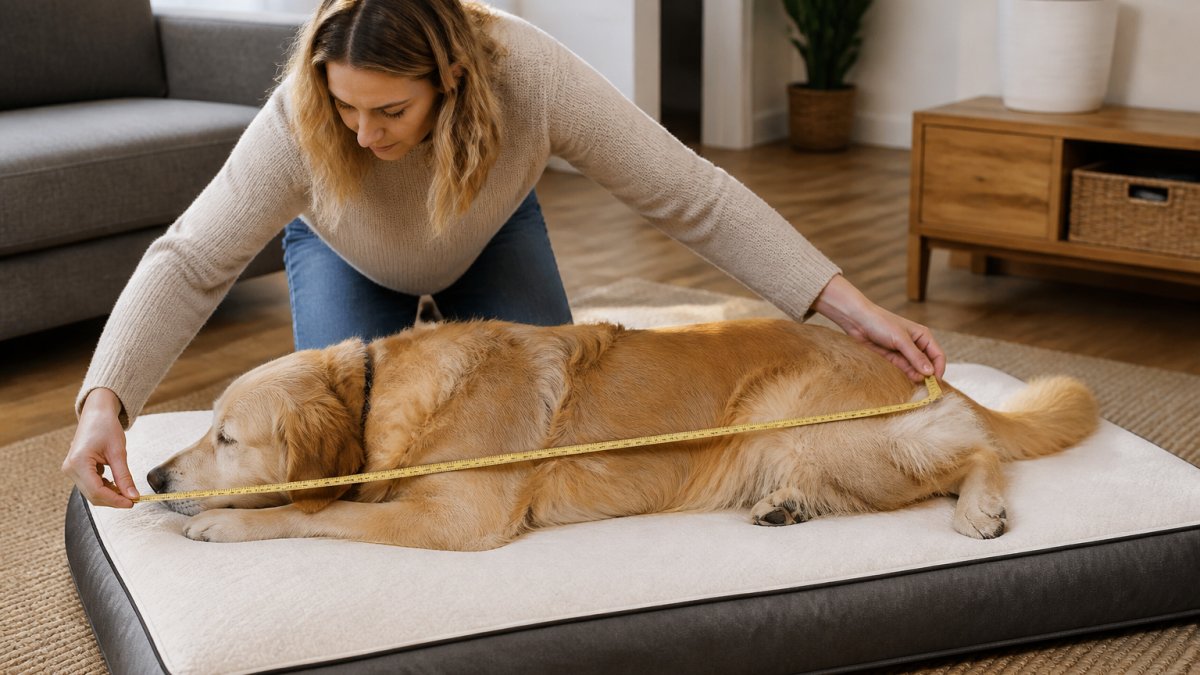
Step 1: Catch Your Dog at Rest in Its Usual Position
Wait until your dog settles into deep sleep, not the polite settle it does when you are watching. Note whether it sleeps stretched flat on its side, curled nose-to-tail, sprawled on its belly with legs out, or propped against a wall or furniture. You will measure the preferred position, then add margin for the others.
Step 2: Measure Length and Width in That Position
Use a soft measuring tape and measure the dog, not the floor. For a flat sleeper, run the tape from nose tip to tail base (not the tail tip, which usually curls away).
Write down both numbers. Owners often underestimate width because they measure the torso and forget the elbows and hips that splay out at rest.
Step 3: Add Position-Specific Margin
The margin you add depends on how the dog sleeps:
- Flat stretchers: add 4 to 6 inches to length and 2 to 4 inches to width so the dog can roll side to side without a paw hanging off.
- Curlers: add 4 to 6 inches to the diameter so the dog can circle before lying down without its nose pressing the bolster.
- Sprawlers: add 6 to 8 inches to length and 4 to 6 inches to width; sprawlers shift position most and need the most open surface.
Step 4: Match the Measurement to Listed Bed Dimensions
Most listings give outer dimensions. Subtract the bolster width (often 4 to 8 inches per side on bolster beds) to estimate usable sleeping surface. If bolster width isn’t stated, assume the usable area is smaller than the outer number and size up. You can compare sizing against our Premium Extra Large Orthopedic Dog Bed if you’re fitting a big dog.
Measure twice on two different days. Dogs settle differently when tired versus alert, and the larger of the two measurements is the safer basis for sizing.
Curl Up, Lie Flat, or Stretch Out: Matching Bed Shape to Sleep Style
Bed shape should follow sleep style. Curlers and leaners do well with a bolster bed, where raised sides give something to press against and a sense of security.
If your dog curls against a side, an oversized bolster-style bed matches that habit; our Luxury Oversized Orthopedic Dog Bed is built for exactly that sleep style.
Support Needs by Condition, Age, and Breed (and When to Call Your Vet)
Support needs shift with the dog, and the biggest mistake buyers make is treating “orthopedic” as a single specification. A bed that suits a fit three-year-old Labrador is not the right bed for a 12-year-old dog with hip arthritis, even if both weigh the same. The guidance below separates comfort support from medical treatment and gives condition-specific considerations, because a bed is a comfort product, not a therapy device.
Senior Dogs and Dogs With Arthritis
Senior dogs and dogs with arthritis generally benefit from pressure-relieving memory foam and easy, low-step access. Two details matter more than the label: entry height and edge support.
A thick, firm bed can be hard for a senior dog to get on and off, which may lead the dog to avoid it. If your dog stands at the edge and hesitates, the entry is the problem, not the foam.
Large and Giant Breeds
Large and giant breeds need denser foam and a non-slip base so the bed doesn’t slide when they push off. A 100-pound dog concentrates load on hips and elbows, and egg-crate or low-density foam bottoms out within weeks. Prioritize a solid high-density core over a plush top layer, and check that the base has a textured or rubberized underside rather than smooth fabric.
Dogs With Limited Mobility or Pressure-Sore Risk
This is the group most buying guides skip. Dogs recovering from surgery, dogs with degenerative joint disease, and dogs that spend long hours lying down have different needs than an active dog. Considerations include:
- Low entry: a bed the dog can walk onto without lifting a leg over a bolster.
- Bolster height: bolsters should support the head and back without blocking the dog’s swing path when it rises.
- Grip: a non-slip base and a cover that is not slick help a dog push up without sliding.
If your dog has existing pressure sores or reddened skin over bony points, a bed alone will not resolve it. That is a veterinary issue, and bedding should be chosen in consultation with your vet.
Active and Working Dogs
Active dogs do better with firmer, resilient foam that recovers quickly. A dog that jumps on and off a bed dozens of times a day will compress soft memory foam into a permanent hollow faster than one that sleeps through the night. A high-density base with a thinner comfort layer balances support and durability.
When to Call Your Vet Instead of Shopping
A bed is a comfort product, not a treatment. If your dog is limping, reluctant to rise, showing new stiffness, dragging a limb, or has a wound or sore that will not heal, that’s a conversation with your veterinarian, not a shopping decision. For a deeper look at beds built around specific conditions, our guide to the best orthopedic beds for senior dogs covers age-related needs in detail.
Do not use a bed purchase to delay a vet visit. Sudden reluctance to walk, yelping when lifted, or a dog that cannot rise without help are signs to call your veterinarian promptly.
How to Clean an Orthopedic Dog Bed Without Breaking Down the Foam
How to clean an orthopedic dog bed comes down to protecting the foam core. Most foam breaks down when soaked and machine-dried, so the safe routine is a removable, washable cover washed on a gentle cycle and air-dried, with the foam core spot-cleaned and left to air out fully.
- Vacuum loose hair and debris from the cover and seams
- Unzip and wash the cover on a gentle, cool cycle
- Spot-clean foam stains with a damp cloth and mild soap
Watch out: putting the foam core in a dryer can warp it and crush the cell structure that provides support.
Temperature, Breathability, and Bed Lifespan: What Buyers Overlook
Heat and breathability matter more than most buyers expect. Breathable covers and cooling options help a dog stay comfortable year-round; if heat is a concern, a cooling orthopedic option is worth comparing.
Lifespan ties back to foam quality. A dense solid core with a washable cover and a non-slip base generally holds its shape longer than egg-crate foam.
Choosing Your Orthopedic Dog Bed at Paw Pro Source
Choosing well means matching orthopedic dog beds to your dog by foam, thickness, and shape rather than shopping by label. One more thing before you buy: dogs sometimes reject a new bed out of habit, and our guide on why dogs ignore new beds explains how to ease the transition.
Best for: owners who want a support-first bed matched to their dog’s weight and sleep style.
Skip if: your dog needs veterinary care for a joint problem; see your vet first.
Frequently Asked Questions
What should I look for in an orthopedic dog bed?
Start with the foam, not the label. Look for high-density solid foam (often rated 4+ lb/cu ft) rather than shredded fill, a thickness that matches your dog’s weight, and a removable, washable cover. Check for a non-slip base and reinforced edges if your dog struggles to climb in. The term orthopedic is not regulated, so ask what the bed is actually made of and how the foam is layered before you buy.
How do I choose the right size orthopedic bed for my dog?
Measure your dog from nose to the base of the tail while it lies in its usual sleeping position, then add 6 to 12 inches so the dog can stretch out. For curl-up sleepers, a round or oval bed one size up from the measured length works well; for dogs that lie flat or stretch out, choose a mattress-style bed long enough for full extension. An orthopedic dog bed size guide should account for sleep style, not just breed weight charts.
Is memory foam or orthopedic foam better for dogs?
Memory foam contours to the body and relieves pressure points, which suits senior dogs and dogs with arthritis. Conventional orthopedic foam, often a denser solid layer, gives firmer, more even support and holds up better for heavy or active dogs. Many quality beds combine both: a dense base for stability and a memory foam top for pressure relief. Match the foam to your dog’s weight and mobility rather than assuming one is always better.
Are orthopedic dog beds good for senior dogs?
They can be, because denser foam spreads weight and reduces pressure on joints that stiffen with age. Senior dogs also benefit from low-profile or step-up designs so they do not have to jump, plus a non-slip base on hard floors. If your dog has diagnosed arthritis or hip issues, ask your veterinarian whether a firmer or softer surface is appropriate before buying.
What is the difference between an orthopedic and a plush dog bed?
A plush bed is built for warmth and cuddling, usually with fiberfill or soft bolsters that compress under weight. An orthopedic bed uses dense foam to support the body and keep joints off hard surfaces. Plush suits young, healthy dogs that like to nest; orthopedic beds suit seniors, large breeds, and dogs with joint issues. Some beds pair a foam base with plush bolsters for both support and comfort.
How thick should an orthopedic dog bed be?
Thickness should track weight and sleep style. Lighter dogs can do well on 2 to 3 inches of foam, while heavier dogs generally need 4 to 6 inches of solid, high-density foam to keep hips and elbows from bottoming out. Dogs that lie flat benefit from a longer, slightly thicker mattress; curl-up sleepers can use a thicker bolster around a moderate base. Check that the foam does not compress to the floor under your dog’s weight.
How often should I replace my dog’s orthopedic bed?
Replace the bed when the foam no longer springs back, when it stays compressed after your dog gets up, or when the cover is torn beyond repair. For a large dog on a quality foam bed, that is often every two to three years; smaller dogs may get longer. Wash the cover regularly and air the foam, and check the warranty, since some manufacturers cover foam compression separately from fabric damage.
The right orthopedic bed comes down to reading the foam, measuring the sleeping dog, and matching shape to how your dog actually rests. Paw Pro Source makes that easier with a curated selection of comfort-focused pet products, practical everyday essentials, and a range of beds built for real sleep styles. Get started with Paw Pro Source and give your dog the support it deserves.



0 Comments